

The First Banking AI Application
In 1984 I designed an AI app for Citibank and I led the team that implemented it in Lisp

The news last month was that Bank of New York (BNY), the oldest bank in the U.S., signed a multiyear relationship with OpenAI. In the deal, BNY gets to use cutting-edge OpenAI tools including Deep Research and ChatGPT Enterprise. In exchange, OpenAI gains valuable experience applying its technology to complex tasks in the real world. The Wall Street Journal reported the story on February 27th, 2025, writing:
Banks are emerging as early leaders in AI adoption and as top-filers in AI patents.
Big money center banks have always been early adopters of new technologies. I know from experience; I designed an AI system for Citibank in 1984 that was the first AI application for a major money center bank. It sounds unbelievable, I know, but I have the documentation: I presented a research paper about the project in 1989 at the very first applied AI conference, the Innovative Applications in Artificial Intelligence (IAAI) conference of the American Association of Artificial Intelligence (AAAI).
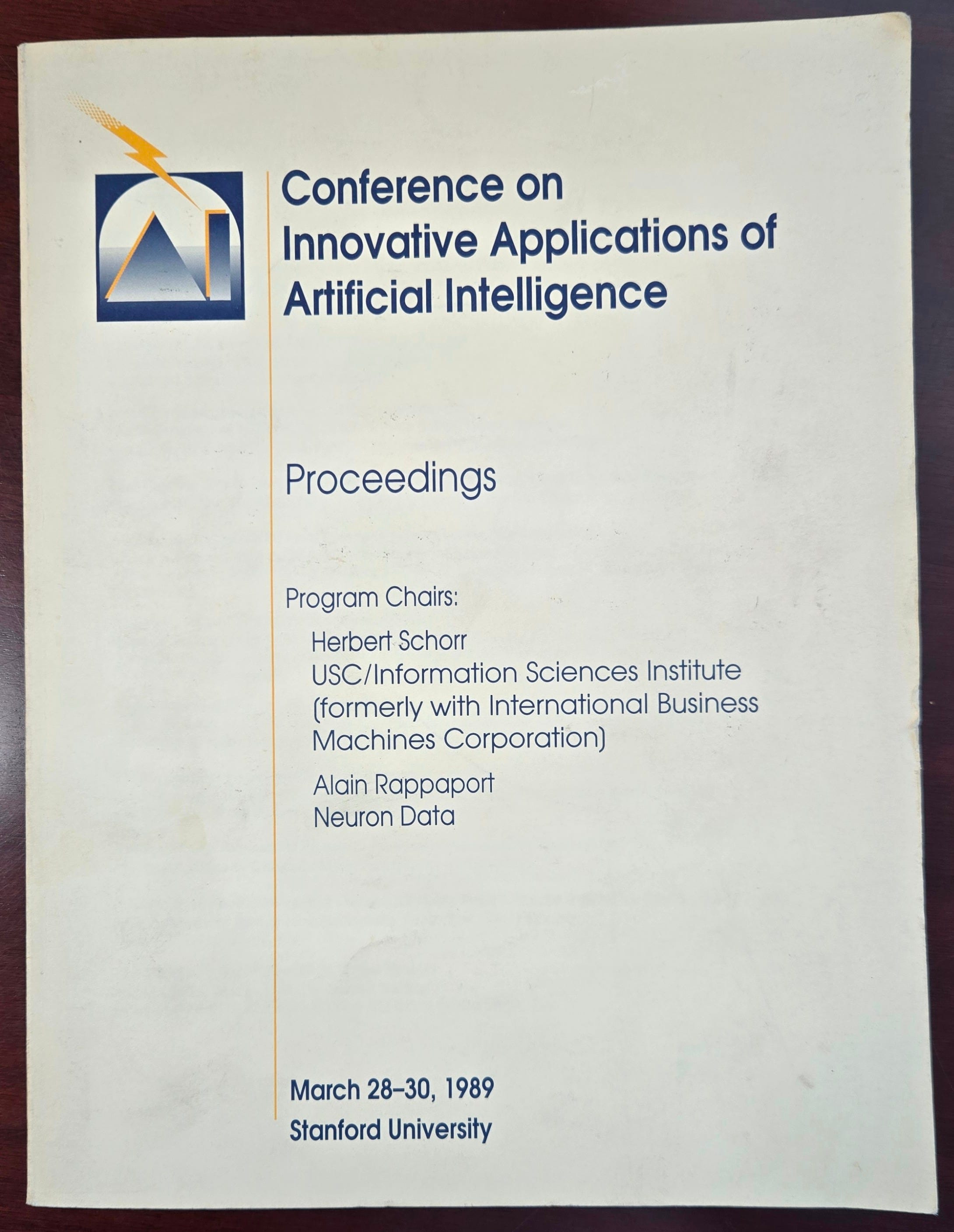
My co-author, Kenan Sahin, was the president of our consulting firm, CMD. Because our application was the first use of AI in banking, the title of our presentation was, simply,
“The Intelligent Banking System.”
IBS was the first banking app to use the techniques of natural language processing and rule-based expert systems, both of which I learned in my undergraduate and graduate classes in MIT’s department of computer science and electrical engineering. Within Citibank, the system was branded as CitiExpert, because it was the first and only expert system at Citibank. When you’re the first, you get to call it whatever you want. Here’s how we described IBS/CitiExpert in our 1989 conference paper:
The goal of the IBS is to allow the computer to scan and “understand” a natural language text message. The knowledge domain for IBS is the reading and translating of English text messages into a structured format. The system combines elements of flexible parsers, case frame grammars, semantic grammars, and augmented transition networks.
Maybe there was another AI banking app before 1984, somewhere, but when we claimed ours was the first at the 1989 conference, five years after our first implementation, no one in the AI world objected. There may have been an earlier app that was a trade secret or that the developers didn’t make public. If so, please let me know in the comments! (ChatGPT told me that American Express developed a system in 1982 but that it was only a prototype.) At the end of this post, I include the complete text of the paper.
With the confidence of youth (I was in my twenties), not only did we ambitiously call the system “The Intelligent Banking System” but we also called our user interface “The Intelligent Banking Workstation” or IBW. That’s also described in our IAAI paper. (It had multiple windows and you could use a mouse! Imagine that!) It ran on a Lisp Machine, and the entire app was written in Lisp, which was the language I learned doing my undergraduate thesis at the MIT AI Lab in 1982. Back in the day, if you were doing AI, you were doing it in Lisp. I loved that programming language! I asked ChatGPT what programmers today think about Lisp. They say that Lisp is:
Philosophically beautiful
A language for thinking
The language of the gods
The most elegant language
I wouldn’t have put it that way, but, sure. Those programmers probably never developed a full-fledged real-world application using Lisp. As with any language, it’s a love-hate relationship.
Back in the 1980s, big banks supported international trade through their funds transfer networks. A single transaction was often millions of dollars, flowing from Saudi Arabia to Malaysia to London. For me, a young consultant fresh out of college, it was a pretty heady experience to watch all of this money flowing around between Credit Suisse and Banco Santander and all the London banks. I became intimate with SWIFT, CHIPS, and Fedwire. All of my leftist friends hated banks. Everyone loves to hate banks. But I learned that banks make the world go ‘round. IBS/CitiExpert didn’t only do funds transfers. We also applied artificial intelligence to transactions that make global trade possible:
Letter of Credit Issuance
Letter of Credit Reimbursement
Bankers’ Acceptances
The IBS was embedded in existing bank processing systems, and also in telex carrier facilities at Western Union/ITT and TRT. We tried to sell the system to other banks; I opened our New York office so that I could market it. To sell it to another bank, we obviously couldn’t call it “CitiExpert” and that’s why we changed it to IBS.
The idea for an AI system that would process natural language transactions was formed by Kenan Sahin and Citibank’s Carlos Salvatori before Kenan hired me to lead the project. I was the knowledge engineer, the architect, and the project manager, but there were several people on the team who worked hard on this, including the experts at Citibank that taught me about international banking. It wasn’t all AI and Lisp programming; there are some very strict security protocols when you’re handling hundreds of millions of dollars every day! That’s why OpenAI did the deal with Bank of New York: They realized that they need to learn about boring tedious things, about the plumbing that’s necessary underneath their fancy AI algorithms.
Our company, CMD, was later renamed Kenan Systems Corporation (KSC) and went on to fame and fortune with another AI system that I originated and that I named ARBOR, an acronym for Automated Repair of Bills and Order Requests. But that’s another story!
I don’t often talk about my life “before creativity research” but when I read about OpenAI and the Bank of New York, it flashed me back to the 1980s. That experience has definitely informed the way I think about organizational innovation. If you want to learn more about Kenan Systems and CMD, listen to my interview with Kenan on The Science of Creativity podcast.
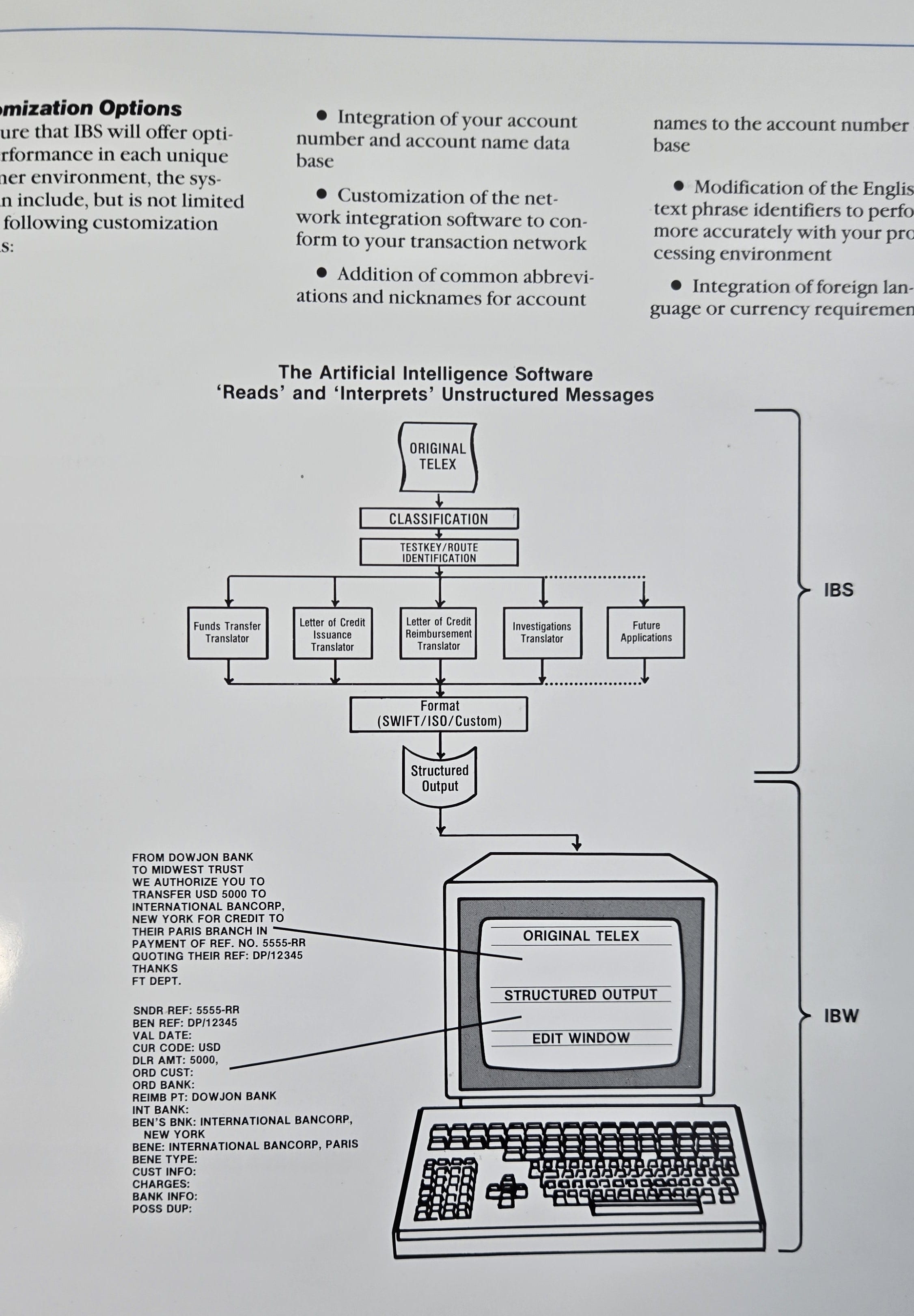
The following academic conference paper can also be found online on the website of the Association for the Advancement of Artificial Intelligence in The Proceedings of the First Conference on Innovative Applications in Artificial Intelligence (1989) and also in a book published by AAAI. Here’s an overview of the architecture of the Intelligent Banking System. Check it out! It “reads” and “interprets” English!
The Intelligent Banking System
Kenan Sahin and Keith Sawyer
Consultants for Management Decisions, Inc., Cambridge, Massachusetts
Published in Innovative Applications in Artificial Intelligence ( IAAI-89) Proceedings (pp. 131-134).
Abstract
This paper describes the Intelligent Banking System (IBS), a family of applications developed for Citibank, New York, by Consultants for Management Decisions (CMD) to increase the productivity and effectiveness of English text message processing. These messages were previously processed manually. Data entry operators would read and analyze the message and then type information at a standard ASCII terminal interface. IBS applies a combination of natural language processing and rule-based expert system techniques to analyze the message and to generate a formatted equivalent. IBS also provides a sophisticated intelligent user interface which aids users by applying the system's domain knowledge to the interactive session.
Introduction
International Banking relies heavily on the electronic transfer of messages for basic transactions. Until the mid-seventies, messages were transmitted over the telex carrier networks, as natural language text. In the mid- to late-seventies, the major international banks developed several industry-wide structured formats to represent the most common banking messages, such as funds transfers. This then allowed the banks to develop computer software which could automatically process the structured transaction, precluding the need for manual intervention. (This parallels the more recent moves to EDI in other industries.)
Despite the widespread success of this strategy in reducing processing costs and increasing bank productivity, a significant minority of the international message traffic remained natural language text. This traffic still required costly and error-prone manual processing. Proficient operators needed a significant understanding of international banking transactions, creating high training costs and limiting staffing flexibility.
Because of the need to process English text input, and the need to incorporate a significant amount of domain expertise, traditional programming techniques were inadequate. Artificial Intelligence technology was identified as the appropriate solution. AI offers two groups of techniques which are used by IBS: Natural Language Processing techniques, and Rule-based Expert System techniques.
The goal of the Intelligent Banking System (IBS) is to use a combination of these techniques to allow the computer to scan and "understand" a natural language text message. Automating the task in this manner would reduce banking costs, increase operator productivity, and reduce the chance of manual error. The task seemed appropriate for this technology, since the application satisfied many of the accepted criteria (Davis, 1982, and Prerau, 1985):
· The domain is characterized by the use of expert knowledge, judgment, and experience.
· Conventional programming solutions are inadequate.
· There are recognized experts that solve the problem today.
· The completed system is expected to have a significant payoff for the corporation.
· The task requires the use of heuristics, or "rules of thumb."
· The task is neither too easy nor too difficult.
· The system can be phased into use gracefully.
IBS System Description
IBS was developed on a custom basis by Consultants for Management Decisions (CMD) for Citibank, New York. IBS was originally developed for the Funds Transfer class of banking messages. The methods and approaches applied to this domain proved readily extensible to other types of banking messages, and IBS has since been extended to several other message domains. Thus, IBS is actually a full family of applications, including the following modules:
· Funds Transfer message processing
· Letter of Credit Issuance message processing
· Letter of Credit Reimbursement message processing
· Funds Transfer problem inquiry message processing
· Message classification (involving an analysis of all telex traffic to determine which domain-specific module is appropriate)
· Testkey parameter identification
All of these modules are fully integrated into various production environments.
Several of the modules are implemented on-site at Citibank. These systems are fully embedded in the existing bank processing systems and are processing live telex traffic on a daily basis.
Several of the modules are also installed in two telex carriers' data processing facilities: Western Union/ITT, and TRT. These telex carriers are offering IBS message enhancement as a service to their banking customers. IBS is fully integrated with the production processing environment at these sites as well.
The funds transfer application, because it was the first to be developed, is perhaps the most mature system. This system is accompanied by the Intelligent Banking Workstation (IBW), which allows an operator to review an IBS-processed message using a window-and-mouse-based interface. IBW allows intelligent entry, which provides the user with full access to the knowledge capabilities of the system. IBW also provides the user with explanations of the various actions taken by the system during the parsing and resolution phases. IBW increases operator productivity further by allowing the operator to make use of partial information identified by the system.
The other applications are not currently accompanied by their own user interfaces, but instead are integrated so closely with the existing production systems that the standard terminal interfaces of the bank processing systems can be used.
The Funds Transfer module has been in production since 1985. This effort followed the original prototype, which was completed by CMD in mid-1984. The total calendar time for the effort to transform the prototype to full production was approximately eight months. This initial production system was implemented on a dedicated LISP machine and was networked using a custom-developed protocol. This implementation proved to be inappropriate for full production, and the system was ported to the VAX environment in 1986.
The later applications began during 1986 and 1987, and were each designed from the beginning for production implementation on the VAX platform (only a brief prototype phase was included).
Technical Description
The knowledge domain for IBS is the reading and translating of English text messages into a structured format. The messages are sent to Citibank electronically via both internal, proprietary networks, and external telex networks. Depending on the message type, the message can be from 80 words long to several pages long.
Message Characteristics
The subset of English used in these messages is highly terse and abbreviated. The people typing in the message are under time pressures, so abbreviations and typographical mistakes are common. Many of the messages are entered by people for whom English is a second language. Often, information that is necessary for the recipient but not required of the sender will be omitted to reduce the sender's message entry time. For example, the name of a bank is often specified without the corresponding account number. In many messages, information is supplied that is not needed by the recipient; this information must be ignored.
The domain is such that a direct mapping from individual phrases to structured values is not possible. The structured values depend on the context of the entire message. Some structured values depend on several different phrases in combination. Some values may depend on a particular combination of yet other structured values. The possible combinations of situations resulting in a given value are thus very large.
Application domains in which combinatorial effects become significant usually do not submit to a cost-effective, traditional programming solution. These complexities are an indication that artificial intelligence techniques may be appropriate.
In addition to these domain requirements, the production environment required that each message be processed in under sixty seconds.
System Design
IBS makes use of a hybrid approach, borrowing ideas from several significant concepts in computational linguistics and in rule-based expert systems. The abbreviated version of English found in these messages led to the use of a flexible parser approach (Hayes & Mouradian 1981). The system combines elements of case frame grammars (Fillmore 1968) and semantic grammars (Hendrix 1977) to arrive at the final linguistic formalism.
This formalism was designed using a variation of the augmented transition network (Woods 1970) to build semantic units. Each semantic unit is responsible for the identification of one key piece of information from the telex. As information is identified, it is stored within the semantic unit.
The characteristics of our formalism satisfied the domain requirements:
· The formalism was capable of identifying single phrases and incomplete sentence fragments.
· The formalism was able to identify useful information and ignore irrelevant information.
· The formalism provided for the identification of abbreviations and misspellings.
By taking maximum advantage of the domain constraints, the formalism provides for highly efficient processing of the English text.
In addition to this linguistic formalism, we employed a rule-based expert system to incorporate domain knowledge. The expert system receives input from the semantic unit values. This expert system is used to make decisions based on overall message content, to infer values using combinations of phrases, and to implement constraints among different structured values. This expert system was also custom-developed to achieve production-level speed performance. In the current version of IBS, the rules have been rewritten directly in LISP code, resulting in a tenfold performance increase.
The true originality of IBS lies in its unique blending of several different research concepts to result in a system that satisfies a specific business goal. Despite the use of these fairly advanced concepts, IBS can still process an average telex in 30 seconds on a machine as small as an IBM PC.
The Intelligent User Interface
IBS was designed to process a message fully, then to pass the message and the corresponding structured information to a user edit interface. IBS identifies an average of over 80% of the structured information. An operator must complete the remaining structured information, usually one or two values.
Many bank data entry stations cannot support the display of both the message and the structured equivalent. These interfaces were designed to be used with a printed copy of the message and provided for structured value entry only. Designing IBS to print out the telex for these operators would have reduced the cost-effectiveness of the process considerably. Instead, we implemented an intelligent assistant, the Intelligent Banking Workstation (IBW) as a companion to IBS. IBW was conceptualized as a low-level assistant to a human operator, providing much of the processing expertise and freeing the operator to perform higher-level conceptual activities (Rich & Waters 1981).
IBW employs mouse cursor control, multiple windows, and pop-up menus and windows to improve operator productivity. Two primary windows are displayed: One containing the original message, and the other containing the structured values identified automatically. The mouse can be used to mark a region of text in the message window and move that text into one of the structured values.
Incomplete or ambiguous values identified by IBS are made available to the user through pop-up windows. One such window is for English-text notifications of problems encountered during processing. A second window contains suggested values which are each mouse-selectable. For example, if several branches are found in the IBS bank database for the name "CREDIT SUISSE," the notification window would say "Several branches found for CREDIT SUISSE," and the suggested values menu would display each of the branches, along with the corresponding city and account numbers. This mechanism allows the user to benefit even when IBS cannot uniquely identify a value.
The linguistic and domain knowledge used in the automatic processing is also available to the user. For example, when a region of text is moved to a structured value using the mouse, the user can request intelligent processing for that text. The parsers and domain rules are then invoked to process the text. A correctly processed value will be entered by IBW. In addition, other values which may have been affected by this change will be flagged with a notification for the user.
This intelligent user interface is a significant value-added component of IBS. The power of the "intelligent assistant" concept, employing mouse cursor control, multiple windows, and pop-up menus, significantly increases the productivity of the users. Providing a broad interface between the users and the intelligence in the system results in maximum value for the knowledge engineering effort.
Success Criteria and Payoff
The application was determined to be successful if over 80% of the information in an average telex was identified automatically, and if each telex could be processed in a short-enough period of time to be cost-effective (approximately 30 seconds for most message types). Each of the many IBS modules has met or exceeded this criteria. At this success level, implementation of the module is considered cost-effective.
The payoff for each of the modules varies depending on the specifics of the installation site. Since each module is installed in varying configurations (telex carrier site vs. money-center bank), the cost savings do vary. Generally, the savings can be characterized by reduced head count, increased customer satisfaction, and lower costs resulting from data entry error.
Acknowledgments
The authors would like to emphasize that IBS is the result of a collaborative effort involving many people too numerous to mention. The authors would like to recognize the key efforts of John Hodgkinson at CMD, and the critical efforts of all involved at Citibank.
References
Davis, R. "Expert Systems: Where Are We? and Where Do We Go From Here?" MIT AI Memo No. 665, 1982.
Fillmore, C. "The Case for Case." In E. Bach and R. Harms (eds.) Universals in Linguistic Theory. New York: Holt, Rinehart, and Winston, 1968.
Hayes, J.H. and G.V. Mouradian, "Flexible Parsing." American Journal of Computational Linguistics, 7 (1981), 4, pp. 232-242.
Hendrix, G.G. "The LIFER Manual: A Guide to Building Practical Natural Language Interfaces," Technical Note 138, SRI International, 1977.
Prerau, D.S. "Selection of an Appropriate Domain for an Expert System." AI Magazine, 6 (1985), 2, pp. 26-30.
Rich, C., and Waters, R.C. "Abstraction, Inspection, and Debugging in Programming." MIT AI Memo No. 634, 1981.
Woods, W.A. "Transition Network Grammars for Natural Language Analysis."
Communications of the ACM, 13 (1970), pp. 591-606.
you continue to amaze me. I had no idea. Best wishes, using Explaining Creativity again this summer in my teaching at University of Florida. I am engaged in writing chapters about AI and music teaching and a chapter on music psychology —each with Oxford.
You certainly have a strong claim Keith! I've checked a booklet I co-authored in 1989 on "Benefits and Risks of Knowledge-based Systems". That has a section on applications of AI in Finance. It mentions the Personal Financial Planning System from Chase Lincoln First Bank - a project that was started in 1983 and went into operation in late 1987. So if your AI system was in operation by 1984 then that beats it - especially if it combines domain reasoning, heuristics and natural language processing. (The booklet also has sections on autonomous vehicles, battlefield management systems, and AI for medicine, psychotherapy, stock dealing, education and law - all very much current issues.)